

Two Free E-Learning Courses to Strengthen India’s Handloom Skill Ecosystem
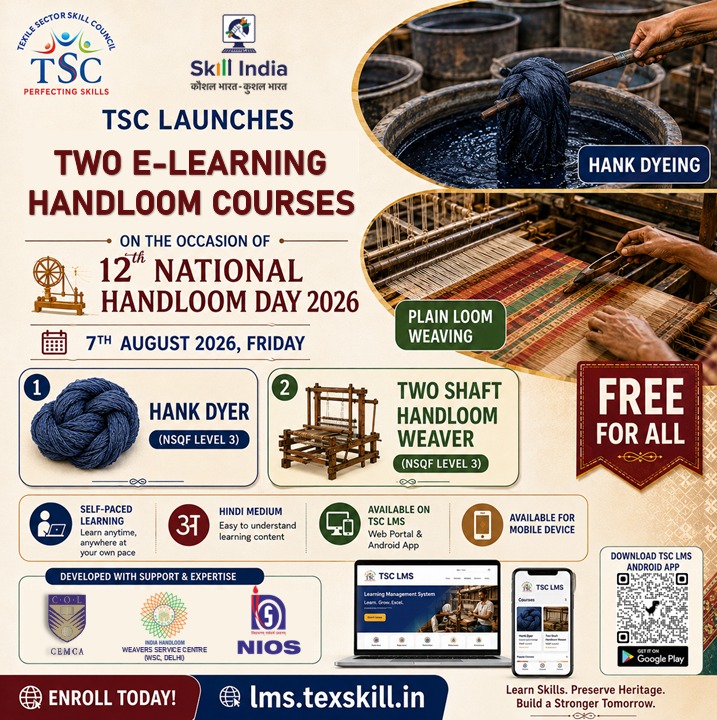
On the occasion of the 12th National Handloom Day, the Textile Sector Skill Council (TSC) in collaboration with the Commonwealth Educational Media Centre for Asia (COL-CEMCA) has launched two free, self-paced e-learning courses aimed at expanding access to quality skill training and supporting the preservation and modernisation of India’s rich handloom heritage.
The initiative leverages digital learning to bridge access gaps in skill development, particularly for learners, artisans and aspiring workers seeking flexible opportunities to build competencies in the handloom sector.
The newly launched courses—Hank Dyer (NSQF Level 3) and Two Shaft Handloom Weaver (NSQF Level 3)—are designed to provide learners with accessible, structured training in key handloom occupations. The courses are available in Hindi, enabling learners to acquire skills at their own pace and from any location.
The courses have been developed with the support of COL-CEMCA, along with the technical expertise of the Weavers Service Centre (WSC), New Delhi, and the National Institute of Open Schooling (NIOS). The collaboration brings together expertise in digital learning, handloom skills and open and flexible education to create accessible learning pathways for the sector.
The Hank Dyer course focuses on the knowledge and skills associated with hank dyeing, an important process in preparing yarn for handloom production. The Two Shaft Handloom Weaver course introduces learners to the fundamentals of weaving using a two-shaft handloom, providing foundational occupational skills relevant to handloom production.
Both courses are available free of cost through the TSC Learning Management System (LMS) and its Android mobile application, allowing learners to access course content through both web and mobile platforms.
🎓 Learn at your own pace.
🌐Enrol today: https://lms.texskill.in
📲 Mobile App: https://lnkd.in/gE5FdWRp
With the initiative, COL-CEMCA and TSC aims to make handloom skill training more inclusive, flexible and accessible, while contributing to the preservation of traditional knowledge and strengthening pathways to livelihoods in the textile sector.
Learn skills. Preserve heritage. Build a stronger tomorrow.