

Regional Workshop Strengthens Graduate Employability and Career Readiness in Northeast India
Guwahati, June 6, 2026
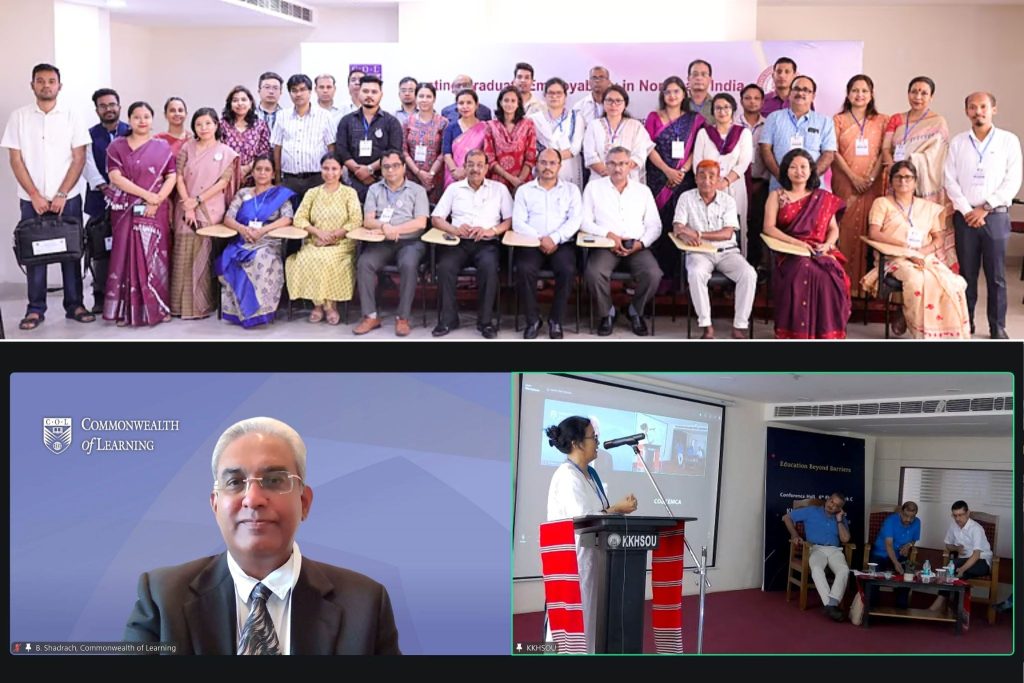
A three-day Regional Workshop-cum-Capacity Building Programme on “Boosting Graduate Employability in Northeast India” concluded at the City Campus of Krishna Kanta Handiqui State Open University (KKHSOU), Khanapara, Guwahati, from 4–6 June 2026. The programme was jointly organised by the Commonwealth of Learning–Commonwealth Educational Media Centre for Asia (COL-CEMCA), and KKHSOU, Assam.
The workshop brought together around 40 faculty members, academic leaders, and practitioners from higher education institutions across Assam, Arunachal Pradesh, Meghalaya, Mizoram, and other states of Northeast India. The initiative aimed to strengthen institutional capacities for enhancing graduate employability and career readiness through curriculum transformation, skill-based learning, and industry-aligned educational practices.
Welcoming the participants, Prof. Pranab Saikia, Registrar, KKHSOU, outlined the objectives of the workshop and underscored the need for institutions to integrate employability, entrepreneurship, and lifelong learning perspectives into academic programmes. He also highlighted the relevance of the National Education Policy (NEP) 2020 in promoting skill-based and outcome-oriented learning.
In his keynote address, Dr. B. Shadrach, Director, COL-CEMCA, highlighted the COL-CEMCA Graduate Employability Model and elaborated the different phases of its implementation in the Higher Educational Institutions. Referring to the large number of graduates who still need employability and career readiness skills, particularly in the NE region, he encouraged participating institutions to develop draft institutional employability frameworks based on the COL-CEMCA model during the workshop and take it forward in their respective institutions.
The three-day workshop featured a series of expert-led sessions covering themes such as understanding employability in higher education, NEP 2020 and skill-based learning, identifying core and soft skills required in the 21st-century workplace, enhancing courses with employability attributes, and integrating skill-based courses within existing curricula.
A major highlight of the workshop was the introduction of the COL-CEMCA Graduate Employability Model and Employability Scorecard, which provided participants with a structured framework for assessing and enhancing graduate employability within their institutions. Through interactive group activities and collaborative discussions, participants reviewed and contextualised employability indicators, identified institutional priorities, and explored strategies for strengthening graduate attributes, curriculum design, skill development, and alignment with evolving labour market expectations.
The final day of the programme focused on developing institution-specific Graduate Employability Frameworks. Participants worked in groups to prepare draft frameworks tailored to their institutional contexts and presented their recommendations for peer review and expert feedback. The presentations generated rich discussions on policy, curriculum innovation, stakeholder engagement, and implementation strategies.
The workshop marked an important step towards building a regional network of higher education institutions committed to improving graduate employability and career readiness. The deliberations and institutional frameworks developed during the programme are expected to contribute to future collaborative initiatives and support the advancement of outcome-based and skill-oriented higher education across Northeast India.