

Expert Consultation Reviews Academic and Career Skills (Self-Assessment) Instrument
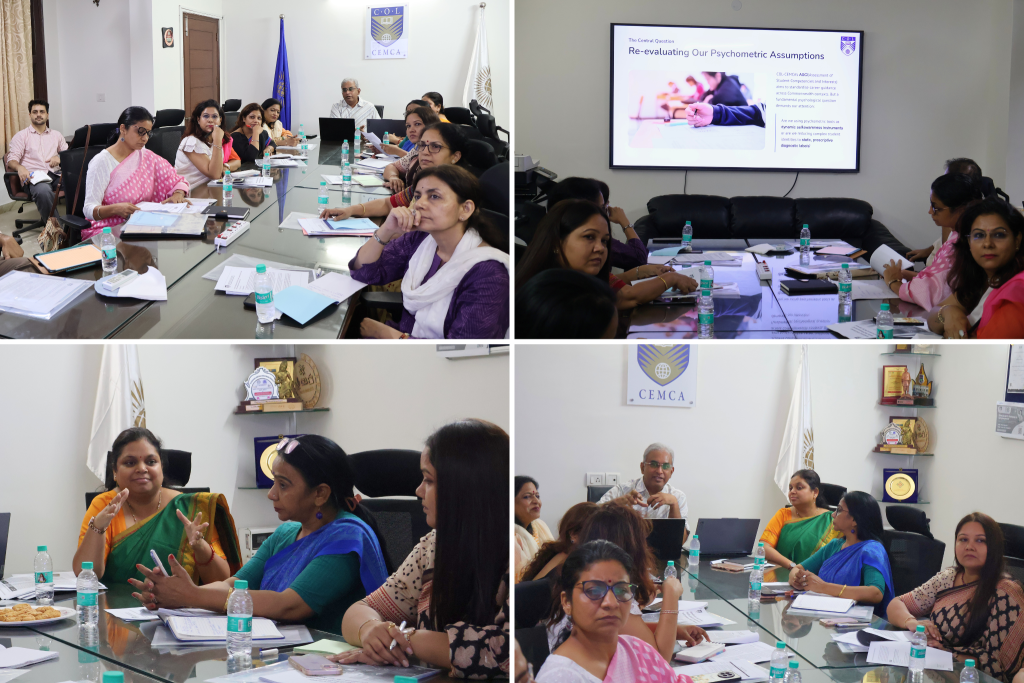
On 24 August 2026, Commonwealth of Learning-Commonwealth Educational Media Centre for Asia (COL-CEMCA) convened an Expert Consultation on the Review of the Academic and Career Skills (Self-Assessment) Instrument (ACSI) developed in collaboration with Central Board of Secondary Education (CBSE), to critically examine the instrument’s conceptual foundation, dimensions, and its alignment with academic, vocational and career pathways.
The consultation brought together experts, psychology practitioners, professors and education professionals and emphasised the need to position ACSI as a tool for self-understanding and exploration, rather than as an instrument that labels students or prescribes a particular career. Experts highlighted that students, particularly at key transition stages such as Classes VIII and X, should be exposed to a wider range of academic, vocational and career possibilities and supported in making informed choices.
Dr. B. Shadrach, Director, COL-CEMCA, underscored that ACSI should communicate possibilities rather than certainty, using exploratory language and recognising that students’ interests and aspirations may evolve with age and exposure. He also stressed the importance of keeping the digital instrument dynamic, allowing information on emerging professions, courses and pathways to be updated in response to technological change, automation and artificial intelligence.
Dr. Pooja Akhsay, Assistant Director for Skill Education, CBSE highlighted the changing educational and vocational-skilling landscape and the need to account for the different developmental stages of students in Classes VIII and X. She also drew attention to the psychological impact of assessment reports, emphasising that interpretations should neither discourage students’ aspirations nor create unwarranted confidence.
The expert discussion examined the eight dimensions of ACSI, their theoretical basis and distinctiveness, the operational definitions and statements used for assessment, the suitability of the existing format, and the alignment of the instrument with contemporary Indian students. Experts also discussed the need to review career mappings in view of digitalisation, automation and AI, while considering qualitative elements that could complement quantitative assessment.
A broad consensus emerged to retain useful elements of the existing ACSI while revisiting its overall vision, theoretical coherence, dimensions, statements and reporting framework. The proposed direction is to strengthen the instrument around self-understanding and self-exploration, with academic and career guidance emerging as an outcome rather than a fixed diagnosis.
The consultation reaffirmed the importance of developing an accessible and contemporary instrument that enables students to understand themselves, recognise evolving interests and explore diverse academic, vocational and career opportunities. The revised ACSI is envisioned as theoretically coherent, developmentally appropriate and dynamic, while opening possibilities for students rather than limiting them.