

COL-CEMCA Convenes National Consultative Meeting of State Open Schools to Advance Vocationalisation Agenda
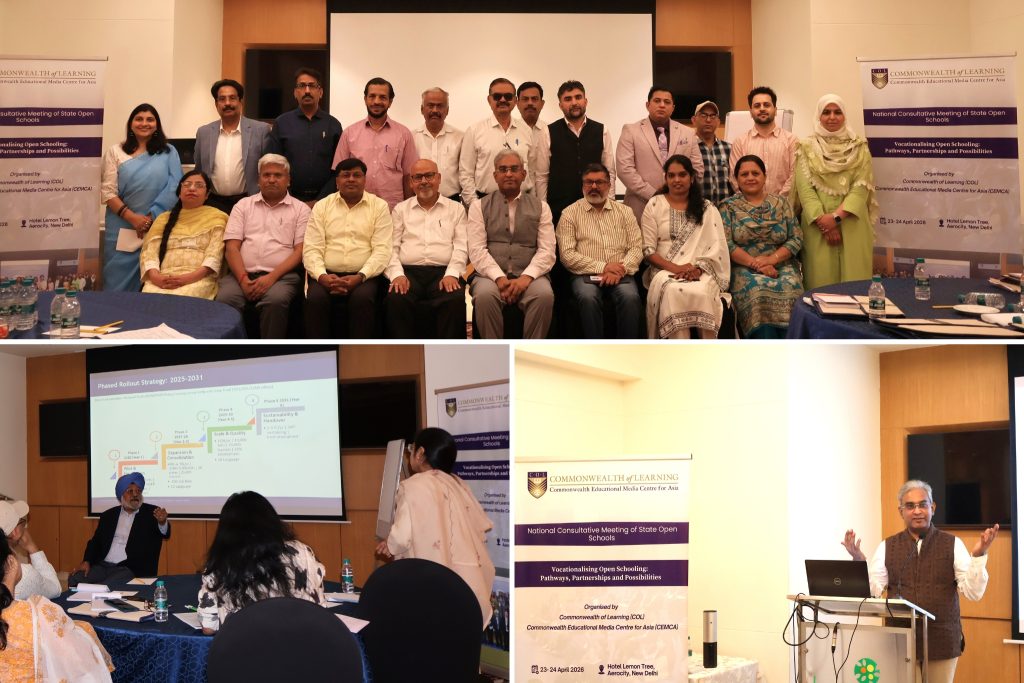
New Delhi, 27 April 2026
The Commonwealth of Learning’s Commonwealth Educational Media Centre for Asia (COL-CEMCA) hosted a two-day National Consultative Meeting of State Open Schools (SOS) on 23–24 April 2026 at Hotel Lemon Tree, Aerocity, New Delhi. Directors and senior representatives from State Open Schools across Bihar, Himachal Pradesh, Jammu & Kashmir, Karnataka, Kerala, Madhya Pradesh, Punjab, Rajasthan, Sikkim and Telangana participated, alongside experts from NIOS, NCVET, and the Directorate General of Training.
Speaking at the inaugural session, Dr B. Shadrach, Director COL-CEMCA, highlighted the critical role of open schooling in addressing the educational needs of millions of out-of-school children in India, while acknowledging persistent structural challenges such as social stigma, weak institutional support, digital exclusion, and administrative inefficiencies. He underscored the stark gap between the potential of State Open Schools and their current reach—serving less than 10% of the nearly 2 crore eligible learners—despite rising dropout rates at the secondary level. He also emphasised integrating vocational pathways and building community trust to make open schooling a credible and inclusive route toward improved enrolment by 2030.
Day 1, themed ‘Understanding the Landscape‘, featured presentations by ten State Open Schools on their current enrolment, standout practices, and challenges, chaired by Dr T N Giri of NIOS. A facilitated mapping exercise enabled delegates to build a shared ‘problem wall’ of systemic challenges across states. Sh. Amit Sharma (NCVET) then presented the regulatory opportunities available to State Open Schools under the national skilling and education frameworks, highlighting the KaushalVerse platform’s integration pathway for school boards seeking dual awarding body status.
Day 2, themed ‘Solutions, Strategy and Commitments‘, featured a comprehensive session by Professor Nirmaljeet Singh Kalsi on the COL-CEMCA Business Plan 2030, which envisions scaling open school vocational enrolment to 12 million learners through a Digital Public Infrastructure encompassing a national LMS, virtual labs, multilingual content, and a real-time education-to-employment dashboard. Sessions by Shri N R Aravindan (DGT) on dual certification for ITI and open school students, Shri Sarabjit Kalsi on Recognition of Prior Learning pathways, and Dr Swapna Mishra of the Textile Sector Skills Council on industry-SOS collaboration models rounded out the technical programme.
Five working groups co-developed strategies across the themes of visibility and promotion, RPL, industry alignment for course development, learner segmentation, and digital and blended approaches. Each group presented plans for 2026–27, recommended activities, proposed stakeholder collaborations, and envisaged outcomes. The meeting concluded with an action planning session in which each State Open School committed to specific follow-up actions, with COL-CEMCA extending its support as part of an agreed collaboration.
“We have policies, frameworks, and infrastructure in place. What is needed now is activation — and a shared national commitment to ensure that millions of learners outside the formal system are not left behind,” Dr Shadrach said in his closing remarks.
The consultation brought into sharp focus the urgent need to activate India’s existing policy frameworks and scale vocational open schooling from its current 40,000 learners to millions. It concluded with a shared understanding of the implementation architecture needed — spanning Digital Public Infrastructure, governance reforms, learner segmentation, and industry partnerships — and a common resolve to engage both national and state governments to build momentum. COL-CEMCA will take forward the Business Plan 2030, with the states as partners in making the case for sustained national investment in open schooling.