

COL-CEMCA and VMOU Organise Three-Day Workshop on RBM and Course Enhancement for Graduate Employability
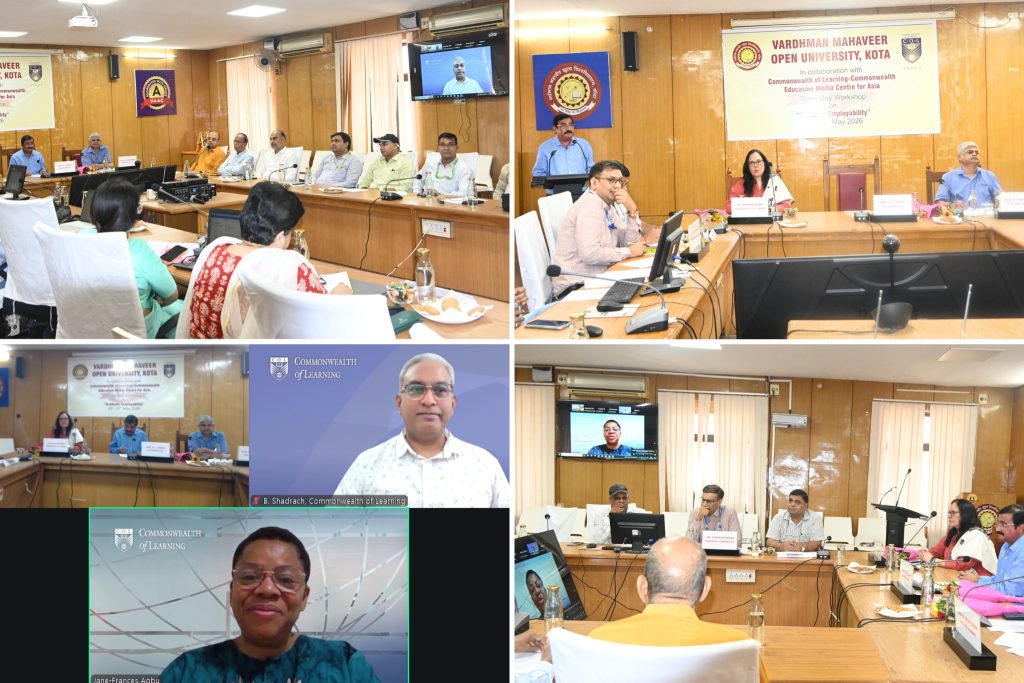
The Commonwealth of Learning- Commonwealth Educational Media Centre (COL-CEMCA) in collaboration with Vardhman Mahaveer Open University (VMOU), Kota organised a three-day capacity-building workshop focused on strengthening graduate employability and institutional planning through skill-based curriculum reforms and Results-Based Management (RBM) practices, on 25-27 May 2026 at VMOU Campus.
Addressing the inaugural session, Prof. B. L. Verma, Vice Chancellor, VMOU highlighted the growing need for courses that can provide immediate employment opportunities to students after graduation. He emphasised that universities must increasingly focus on AI-enabled and hybrid learning models while designing future-ready academic programmes. He also noted that VMOU plans to introduce several new skill-based programmes to enhance employment prospects for learners.
In her opening remarks, Jane-Frances Agbu, Adviser: Higher Education, COL, stressed the importance of transforming teaching curricula to ensure graduates acquire practical and market-relevant competencies. Dr. Agbu described the workshop as an important step in VMOU’s transformation journey and noted that adopting a Results-Based Management (RBM) framework would help the university measure outcomes in employability, skills acquisition, and long-term career success.
In his address, Dr. B. Shadrach, Director COL-CEMCA, positioned VMOU’s transformation as essential to bridging Rajasthan’s critical skills gap, emphasising that the university must strategically align with the state’s industrial needs while focusing on rural entrepreneurship and outcome-based education to ensure graduates possess workplace-ready competencies before graduation.
The workshop on Day 1 focused on integrating Results Based Management (RBM) into VMOU’s Employability Framework and included sessions on results chains, work plans, activity trackers, and Monitoring, Evaluation, Research and Learning (MERL) frameworks. Participants also undertook practical exercises on curriculum integration, job readiness, entrepreneur readiness, employer relations, alumni engagement, and work experience components of the employability framework.
It was followed by sessions on Day 2 and Day 3 on “Course Enhancement for Graduate Employability”. The discussions focused on integrating employability skills and attributes into existing university courses, competency mapping, curriculum redesign, employability-focused learning activities, and the use of Open Educational Resources (OER) and digital resources for instructional enhancement.
The workshop aimed to equip faculty members with skills to revamp their programmes, focusing on employability and competency based learning. In order to create blended learning courses that incorporate openly licensed resources and gender responsive principles, participants will map competencies, match courses with graduate attributes, and create draft course outputs for submission and refinement.