

COL-CEMCA and MNSDA Launch Research Capacity-Building Series for TVET Practitioners in the Maldives
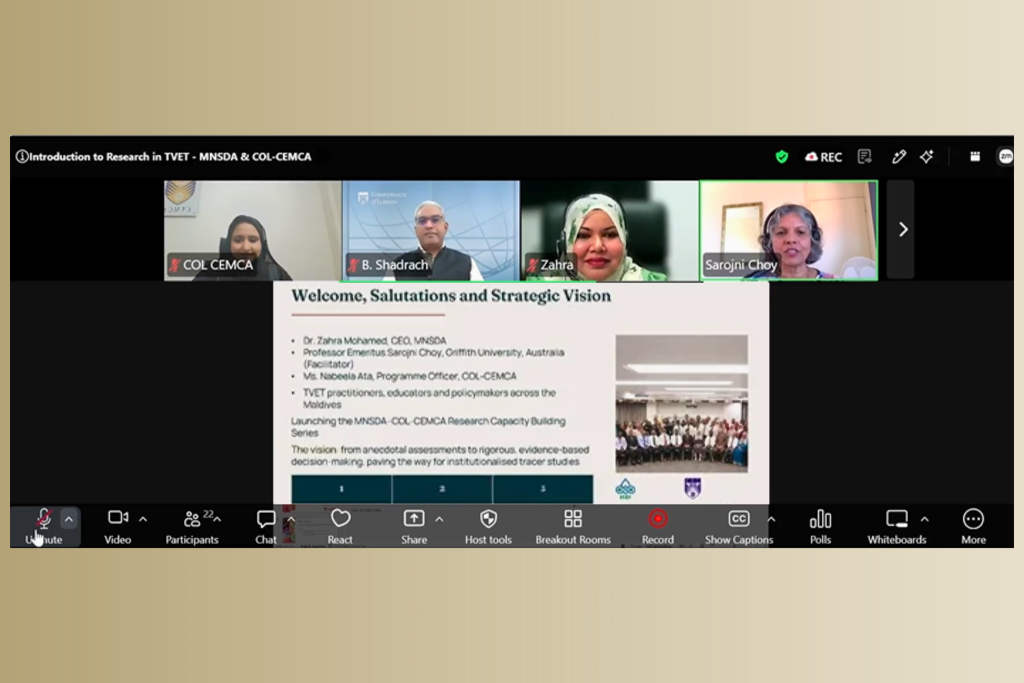
First webinar focuses on strengthening research skills and promoting evidence-based decision-making in Technical and Vocational Education and Training (TVET).
The Commonwealth Educational Media Centre for Asia (COL-CEMCA), in collaboration with the Maldives National Skills Development Authority (MNSDA), organised the first webinar in the Research Capacity Building Series, titled “Introduction to Research in TVET”, on 18 November 2026. The online programme brought together TVET practitioners, educators and policymakers from across the Maldives to strengthen their understanding of research and its application in improving the quality and relevance of TVET programmes.
The webinar opened with a welcome address by Dr. Zahra Mohamed, Chief Executive Officer, MNSDA, who highlighted the importance of building a stronger culture of research within the TVET sector. In both her opening and closing remarks, she emphasised the need for TVET practitioners, educators and policymakers to develop an understanding of research and actively use research findings in their professional practice and decision-making. She underscored that research should not remain an academic exercise but should inform institutional decisions, improve practices and contribute to more effective skills development.
In his opening address, Dr. B. Shadrach, Director, COL-CEMCA, highlighted the importance of moving from anecdotal assessments towards systematic, evidence-based decision-making in TVET. He emphasised that conducting meaningful tracer studies requires a sound understanding of research methods, appropriate research design, reliable sampling and data integrity. He also outlined the wider value of tracer studies in understanding graduate career progression, assessing the relevance of training to workplace requirements, strengthening institutional quality assurance and informing policy and curriculum development.
The webinar was facilitated by Emeritus Professor Sarojni Choy of Griffith University, Australia, and moderated by Ms. Nabeela Ata of COL-CEMCA.
The sessions covered the fundamentals of research in TVET, including the nature and purpose of research, different research approaches, the six main steps in conducting research, and the relationship between research, policy and practice. The second session focused on practical aspects of developing research proposals, designing research projects, survey methods, data collection, quantitative and qualitative data analysis, and reporting research findings. Discussions also explored how these approaches could be applied to future tracer studies to understand graduate employment outcomes, identify skills gaps and assess the relevance of TVET programmes to industry needs.
Strengthening institutional research capacity
Through this initiative, COL-CEMCA and MNSDA seek to strengthen research capabilities among TVET stakeholders and encourage the systematic use of research evidence in institutional planning, programme development and policy formulation. The Research Capacity Building Series marks an important step towards building a stronger research culture within the Maldivian TVET ecosystem.
By supporting practitioners and institutions to understand, undertake and apply research, the collaboration aims to contribute to a more responsive and evidence-informed TVET system in the Maldives.