

COL-CEMCA and GNDU Conclude Commonwealth Asia Workshop on Graduate Employability, Strengthen Regional Institutional Commitments
Amritsar, 28 October 2026
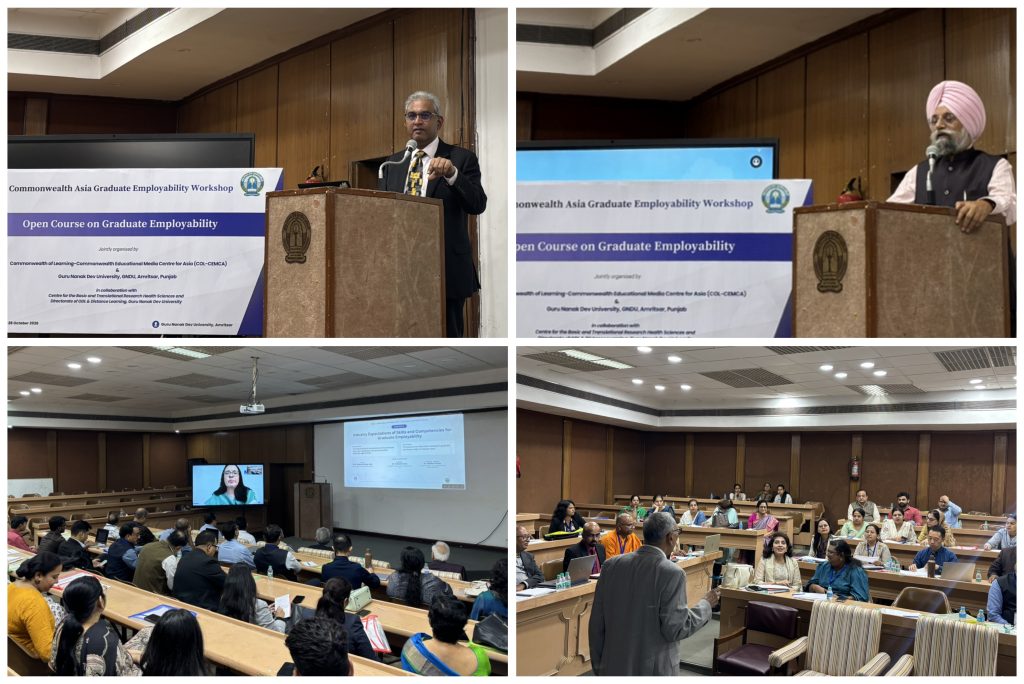
The Commonwealth of Learning–Commonwealth Educational Media Centre for Asia (COL-CEMCA), in collaboration with Guru Nanak Dev University (GNDU), Amritsar, concluded the three-day Commonwealth Asia Capacity-Building Workshop on Graduate Employability, titled Open Course on Graduate Employability, on 28 October 2026 at GNDU.
The workshop brought together around 70 participants from higher education institutions across Commonwealth Asia, including India, Sri Lanka, Malaysia and Brunei Darussalam, to strengthen institutional approaches to graduate employability and advance a shared regional framework.
The workshop provided a platform for academic leaders and faculty members to examine institutional readiness, develop employability strategies and explore ways to integrate graduate attributes into higher education curricula.
Delivering the closing address, Dr. B. Shadrach, Director, COL-CEMCA, emphasised the need to move beyond workshop participation towards institutional leadership and action. He reiterated that graduate employability must be treated as a systemic institutional responsibility rather than an individual student’s burden. Outlining the way forward, he called upon the participants, as Graduate Employability Champions, to mainstream the COL four-phase Employability Model into institutional strategies, undertake state and regional skills gap analyses, convene consultations with university leadership and quality assurance bodies, cascade training to faculty members within six months, and contribute to the development of the regional open course on Graduate Employability. He also highlighted the importance of honouring the institutional commitments made during the workshop and translating the learning into sustainable institutional practices.
Prof. Karamjeet Singh, Vice-Chancellor, GNDU, felicitated the participants and presented certificates recognising their participation and commitment to advancing graduate employability at their respective institutions. He emphasised the importance of sharing knowledge, contributing to society and creating opportunities for collective learning. He urged faculty members to work towards making students more employable through a shared vision, collaborative efforts and a sustained commitment to equipping learners with the knowledge and skills needed for the world of work.
The three-day technical sessions covered institutional readiness assessment using the COL Graduate Employability Model and Employability Readiness Scorecard, followed by discussions on institutional frameworks, Results-Based Management (RBM) and strategic planning. The sessions also explored employer-informed skills gaps, curriculum reform, graduate attributes and the integration of work-based learning into academic programmes, alongside collaborative development of the regional open course on Graduate Employability.
The workshop concluded with a shared commitment to carry forward the learning through institutional action, faculty capacity-building and collaborative development of open educational resources. The initiative marked an important step towards building a regional network of Graduate Employability Champions and strengthening institutional capacity to align higher education with evolving labour-market needs across Commonwealth Asia.