

COL-CEMCA Hosts NCVET Dual Recognition Handholding Workshop for Open Universities
New Delhi | 25 March 2026
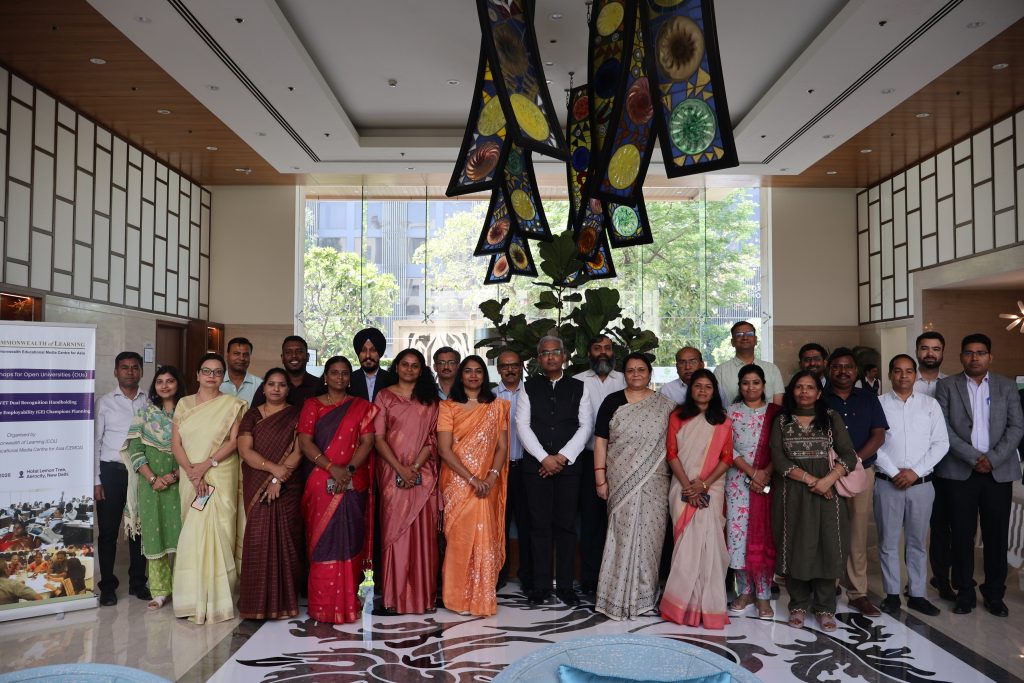
The Commonwealth of Learning–Commonwealth Educational Media Centre for Asia (COL-CEMCA) organised the first of its Strategic Workshops for Open Universities (OUs), focusing on NCVET Dual Recognition Handholding, in New Delhi on 25 March 2026. The workshop brought together representatives from 14 Open Universities (OUs) to accelerate progress toward achieving Awarding Body status under the National Council for Vocational Education and Training (NCVET).
The day commenced with opening remarks by Dr B Shadrach, Director, COL-CEMCA. He emphasised the transformative potential of Open Universities in India’s education ecosystem. He highlighted that OUs, despite being few in number, contribute significantly to national enrolment and play a critical role in reaching underserved and marginalised communities. He underscored the urgent need for OUs to embrace skilling, reskilling, and upskilling as central to their mandate and align with the future of work, positioning themselves as key drivers in achieving the country’s GER targets.
This was followed by a detailed session by Mr. Amit Sharma, Senior Consultant, NCVET, who provided an overview of the NCVET framework and dual recognition process. He outlined the rationale behind NCVET, its role in standardising vocational education, and its alignment with NEP 2020 through credit-based, flexible learning pathways. He also highlighted how becoming an awarding body can enable open universities to strengthen industry linkages, develop market-relevant qualifications, and expand modular learning opportunities.
A key highlight of the workshop was the Application Audit session, where participating open universities candidly presented the challenges hindering their progress. While four universities — IGNOU, KKHSOU, KSOU, and UOU — have successfully achieved dual recognition, the remaining institutions identified several bottlenecks. These included complexities in the application process, challenges in developing industry-aligned qualifications, limited human resource capacity, and a lack of awareness of NCVET processes. Concerns around financial investments and industry validation requirements emerged as the most common barriers.
The afternoon session, titled “Clinic: Application Audit & Technical Support,” provided hands-on guidance to participants. Led by Mr. Amit Sharma along with Mr. Sumer Naryal from TCS (Kaushal Verse), the session featured a live demonstration of the KaushalVerse platform, detailing application procedures, eligibility requirements, fee structures, and documentation processes. Participants received one-on-one counselling and tailored advice, particularly on curating qualifications, identifying job roles, and meeting compliance standards. The interactive session helped clarify key doubts and demystify the application process.
In the concluding session, each university presented a 30-day roadmap toward achieving NCVET recognition. Institutions shared their current status—ranging from those yet to apply, to those in advanced stages, outlined clear timelines and action plans to complete their applications.
The outcomes of the workshop are expected to significantly strengthen the capacity of Open Universities, enabling their transition from training providers to recognised National Awarding Bodies. This shift will enhance the credibility of vocational programmes, ensure alignment with the National Skills Qualification Framework (NSQF), and expand opportunities for learners through flexible, credit-based education pathways.
The workshop marks an important step in advancing India’s skilling ecosystem, positioning Open Universities as key drivers of lifelong learning, employability, and inclusive education.