

World Radio Day 2026 Unites Community Radio Stations for a Stronger Voice
12 February 2026
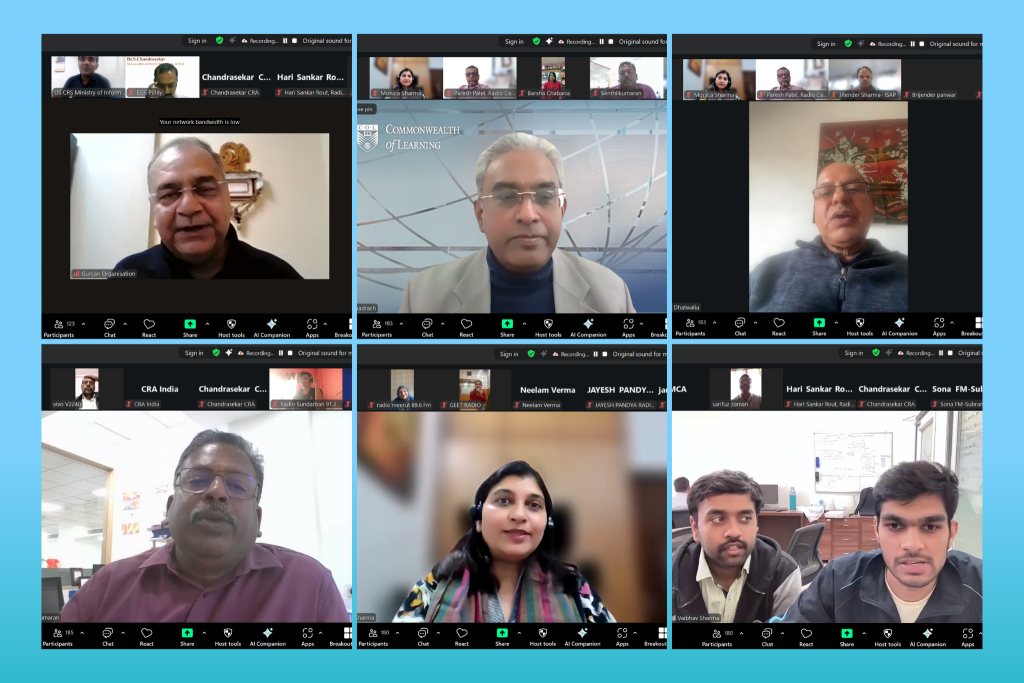
Community Radio Association (CRA), India, in partnership with Commonwealth of Learning – Commonwealth Educational Media Centre for Asia (COL-CEMCA), organised a programme to observe World Radio Day. The virtual event has brought together Community Radio Stations (CRS) representatives from across the region to mark the significance of radio as a powerful medium of communication and social change.
Dr. S. Chandrasekhar, Vice President, CRA, facilitated the session. Mr. Sandeep Parmar, President, CRA, welcomed participants and emphasised the need to responsibly integrate AI with radio, highlighting the importance of collaboration to harness AI’s potential while mitigating its risks.
Mr. Mahendra Kumar Meena, Under Secretary (CRS), Ministry of Information & Broadcasting (MIB), shared the impact of CRS in empowering local voices. He emphasised that AI could enhance CRS capabilities, but cautioned against irresponsible use, ensuring human oversight and ethical practices. He urged CRA and stakeholders to explore innovative initiatives, enhancing capacity and sustainability.
Dr. B. Shadrach, Director, COL-CEMCA, congratulated all radio stations on World Radio Day, appreciating the stellar service in resource constrained areas. He reminded that community radio is ‘by the people, for the people, of the people’. He highlighted MIB’s plans for content collation and distribution, enabling peer learning and AI-based tools for micro programming and offered COL-CEMCA’s support nationwide. He also thanked the Reliance Foundation, National Disaster Management Authority, and others for their support.
Mr. Kuldeep Singh Dhatwalia, Retd. Principal Director General, Press Information Bureau and Director General, Indian Institute of Mass Communication, emphasised that AI can aid data collection, storage, and analysis, but human oversight is important. He urged participants to use AI to facilitate community-based communication, leveraging local languages and participants.
Ms. Monica Sharma, Coordinator, COL-CEMCA, reflected on her long association with community radio and the contribution of community radio to the communities over the years. She shared COL-CEMCA’s commitment to support with capacity building and resources.
Mr. S. Senthilkumaran, Reliance Foundation, emphasised that community radio can leverage AI tools to produce predictive intelligence programmes, enhancing livelihood opportunities and government scheme outreach. He said that AI isn’t replacing humans, but rather acting as a co-pilot. He also highlighted that AI can analyse, give feedback, generate regional language content, and extract audio from videos. He urged for collaboration and also sharing available tools with the interested community, also supporting capacity building and resources.
Mr. Vaibhav Sharma, MS (Research), Department of Electrical Engineering (Computer Technology Group), Indian Institute of Technology (IIT)-Delhi and Mr. Shashwat Bhardwaj, MS (Research) Yardi School of AI, IIT-Delhi, demonstrated Adivani, India’s first AI translator tool for tribal languages. The App was developed by IIT Delhi, BITS Pilani, IIIT Hyderabad, and IIIT Naya Raipur, with tribal research institutes, covering languages like Gondi, Kui, Santali, Mundari, and Garo. The team addressed challenges like data scarcity, script issues, and acoustic sensitivity, and involved community volunteers in workshops to curate data. The App uses a human-feedback loop to improve accuracy, setting it apart from other translation tools. Adivani marks a significant step in promoting tribal languages digitally, making them accessible alongside high-resource languages.