

Public Open Universities Chart National Roadmap for ODL Collaboration & Employability
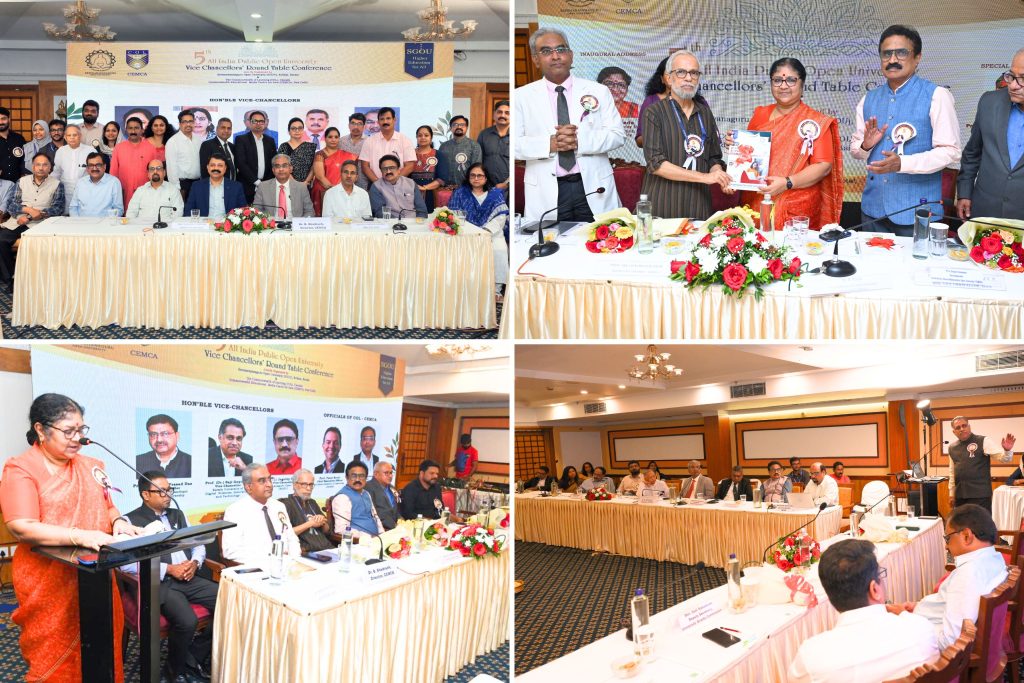
Thiruvananthapuram, Kerala | 25 February 2026
Vice-Chancellors of public open universities from across India convened in Thiruvananthapuram to chart a national roadmap for collaboration, credit mobility, and graduate employability—marking a significant step towards strengthening India’s Open and Distance Learning (ODL) ecosystem.
The Fifth All India Public Open University Vice-Chancellors’ Round Table Conference was hosted by Sreenarayanaguru Open University (SGOU), Kerala in collaboration with Commonwealth of Learning and Commonwealth Educational Media Centre for Asia from 23 to 25 February 2026. The Conference brought together institutional leaders to deliberate on strengthening inter-university cooperation and aligning ODL systems with the goals of the National Education Policy (NEP) 2020.
Inaugurating the Conference, Dr. R. Bindu, Kerala’s Honorable Higher Education Minister, called for a robust national framework for credit transfer and deeper collaboration among open universities. She observed that open universities are “not peripheral, but pivotal” in a rapidly transforming higher education landscape shaped by technology, learner mobility, and the growing demand for lifelong learning. Education, she added, must remain “open, accessible, flexible and transformative,” while highlighting how institutions such as Indira Gandhi National Open University and SGOU have reshaped higher education by expanding opportunities beyond conventional systems.
Delivering the keynote address, Dr. Rajan Gurukkal, Vice-Chairperson of the Higher Education Council, Kerala, urged the teaching community to reinvent themselves as critical intermediaries in an era increasingly shaped by generative AI tools. He cautioned that while such platforms democratise learning, they are also prone to errors, biases, and superficial engagement.
Professor Peter Scott, President and CEO of COL, addressed the Conference via video conference and urged universities worldwide to overhaul their business models and pedagogy as they transition to multi-mode education. He called on institutions to “reimagine learning,” beginning with innovative learning design that integrates interaction, assessment as learning, and social elements to enhance student engagement.
In his Presidential Address, Dr. Jagathy Raj V. P., Vice-Chancellor of SGOU, framed the Round Table Conference as a historic inflection point in the evolution of Open and Distance Learning in India. He urged Vice-Chancellors to move “from dialogue to design, from design to delivery, and from delivery to demonstrable national impact,” transforming the Association of Public Open Universities into an institutionalised collaborative architecture capable of shaping India’s knowledge century.
In his Special Address, Dr. B. Shadrach, Director of CEMCA, provided a strategic and historical framing of the Open University movement’s collective journey. He described the present Round Table as marking the fourth and most critical stage in the evolution of Public Open Universities -transitioning from “Forming, Storming, and Norming” to “Performing.”
During the Conference, SGOU unveiled its Graduate Employability Framework, aimed at strengthening the link between academic programmes and the evolving needs of the labour market. The Framework focuses on embedding employability skills, digital competencies, experiential learning, and work-readiness into undergraduate and postgraduate programmes offered through the ODL mode. It also emphasises industry linkages, career guidance, micro-credentials, and structured pathways for skill integration within degree programmes.
Deliberations underscored the growing strategic role of public open universities in expanding equitable access to higher education – especially for working professionals, women re-entering education, rural learners, and first-generation students. Participants reaffirmed that ODL institutions are central to achieving NEP 2020 objectives on flexibility, multidisciplinary education, credit portability, and lifelong learning.
The Conference concluded with a shared commitment to translate policy intent into actionable frameworks, including:
- Establishing interoperable credit transfer mechanisms
- Strengthening collaboration among public open universities
- Integrating employability and skills within degree programmes
- Enhancing digital and learner support systems
- Presenting a unified policy voice for ODL at the national level
The Conference also featured perspectives from national regulatory and policy leadership, including Prof. Ashok Kumar Gaba (Executive Member, National Council for Vocational Education and Training), Prof. Ganesh Kannabiran (Director, National Assessment and Accreditation Council), and Shri Anandrao V. Patil (Additional Secretary, Ministry of Higher Education, Government of India), who underscored the importance of quality assurance, skills integration, and policy coherence for strengthening ODL systems.
The Conference established a clear direction for collective action. Discussions emphasised that collaboration must replace fragmentation, interoperability must replace isolation, and structured governance must replace informal coordination. The proceedings underscored that credit transfer reform is not merely administrative but structural; digital transformation must be human-centred; skill integration must be strategically embedded; and policy advocacy must be unified and evidence-based.