

Institutionalising Youth in Global AI Governance | Directors’ Panel | India AI Impact Summit 2026
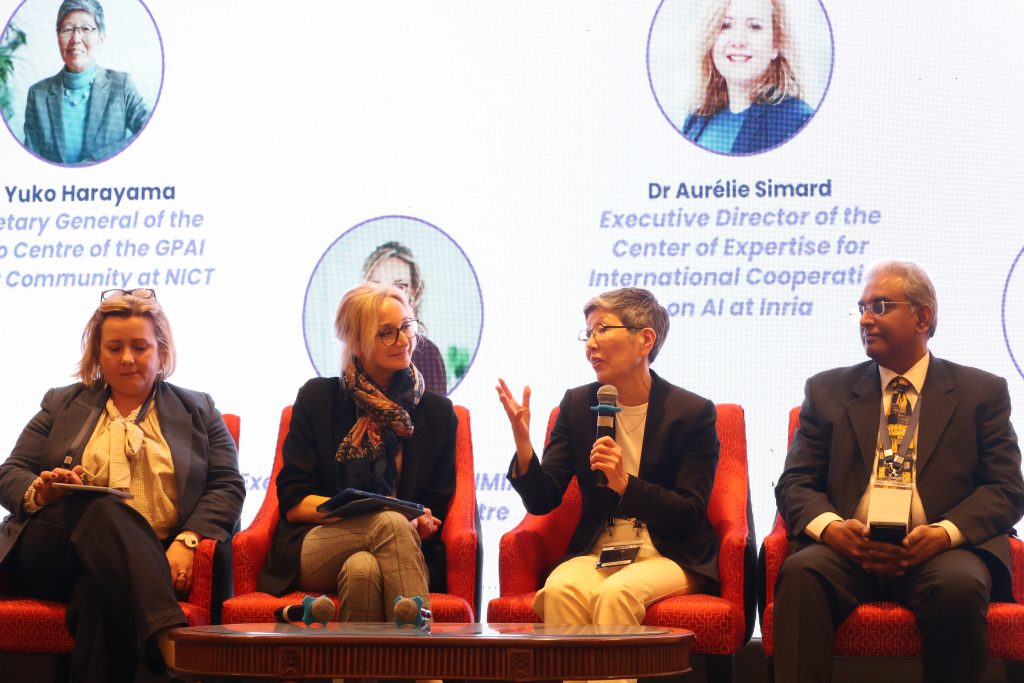
On 18 February, 2026, during the Official Satellite Event, the Directors’ Panel marked a decisive shift in the GPAI-associated India Student Community initiative, from student innovation to governance architecture.
Moderated by Khalid T (CEMCA), the session convened institutional leaders from Japan, Canada, France, and India to examine how youth engagement is evolving within the Global Partnership on Artificial Intelligence ecosystem.
The panel featured:
▪️Dr Yuko Harayama, Secretary General, GPAI Tokyo Expert Support Center, NICT, Japan
▪️Sophie Fallaha, Executive Director, Montreal International Center of Expertise in Artificial Intelligence, CEIMIA, Canada
▪️Dr Aurélie Simard, Ph.D., Executive Director, Center of expertise for the international cooperation on AI affiliated to the GPAI, Inria, France
▪️Dr. B. Shadrach, Director, Commonwealth Educational Media Centre for Asia (COL-CEMCA), India
Rather than discussing participation in abstract terms, the conversation centred on structure, complementarity, and long-term integration.
Across interventions, three strategic ideas emerged.
1️⃣ Youth as Governance Capacity
Directors recognised that student engagement today reflects more than enthusiasm — it signals distributed governance competence.
2️⃣ Complementarity Across National Ecosystems
A key emphasis was that student initiatives across Japan, France, Canada, and India should not replicate one another. The Indian student community was positioned as a distinct structural contributor — bringing multilingual complexity, demographic scale, and lived experience of asymmetrical digital ecosystems.
3️⃣ From Event-Based Engagement to Institutional Continuity
Student engagement must evolve into:
▪️Thematic working clusters
▪️Cross-national methodological collaboration
▪️Defined channels into governance processes
Across the directors’ interventions, one signal was unmistakable: “Students are no longer passive users of technology”
Dr. Shadrach articulated this clearly: students are capable of occupying a global governance seat, advocating for rights-based AI, and transforming their own institutions by pushing for AI policy and guidelines at university level.
Dr. Aurélie Simard reinforced that student engagement strengthens participatory, evidence-based, and resilient governance frameworks, not as consultation, but as structured contribution.
Sophie Fallaha highlighted the intellectual maturity visible in the room: openness to diverse disciplines and geographies, and a genuine will to contribute to international AI dialogue, made possible by unprecedented access to technology.
Dr. Harayama emphasised that today’s generation operates simultaneously as users, developers, and practitioners- a fundamental shift from previous technological eras.