

India GPAI Student Community Launched: Empowering Youth in AI Governance
16 February 2026, New Delhi
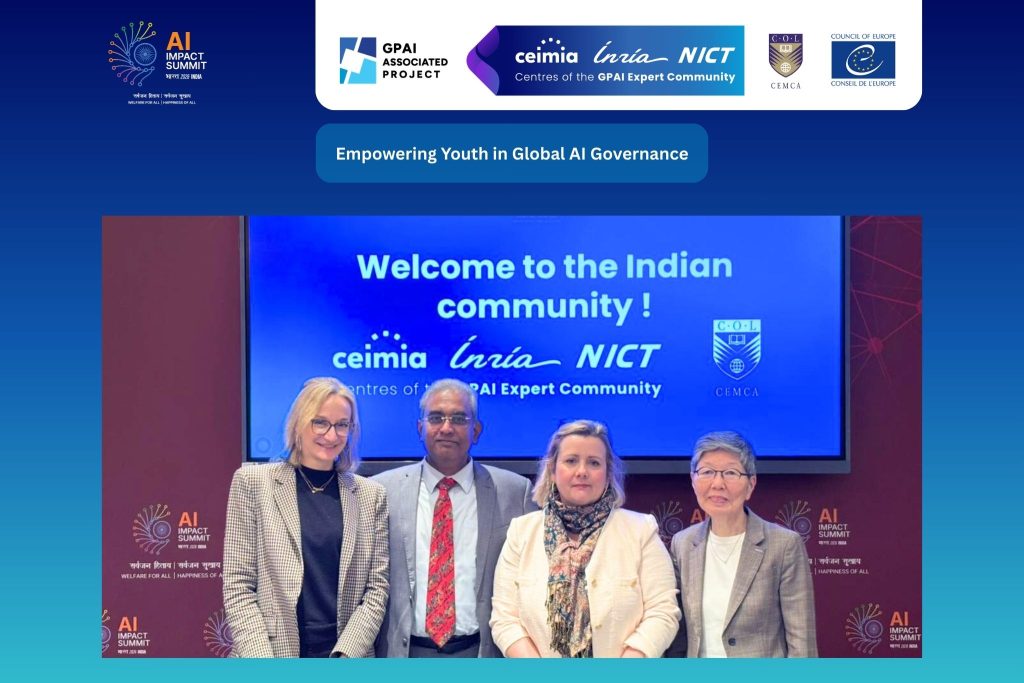
India has officially joined the Global Partnership on Artificial Intelligence (GPAI) community, marking a significant milestone. Dr. B. Shadrach, Director, COL-CEMCA, alongside GPAI community directors, launched the GPAI India chapter, welcoming the Indian student community as its newest members at the India AI Impact Summit 2026 on 16 February 2026.
The event was organised by the Commonwealth of Learning-Commonwealth Education Media Centre for Asia (COL-CEMCA), in collaboration with GPAI experts’ centres CEIMIA (Canada), Inria (France) and NICT (Japan) and the Council of Europe, on the theme. The event brought together students, academic leaders, and international experts from around the world at the Bharat Mandapam, New Delhi, to discuss the theme, “Empowering youth in AI global governance.” Marie-Fleur SIMMET, from Inria, moderated the session.
The opening reflections by Aurélie Simard, Sophie Fallaha, and Yuko Harayama situated youth engagement within GPAI’s broader mandate, emphasising that responsible AI governance must incorporate structured student participation.
Ms. Sophie Fallaha, CEIMIA, introduced the three GPAI centres and the aim to develop practical tools for responsible AI, focusing on trustworthiness, safety, and inclusion. She emphasised it’s support for high-impact projects anchored in science, international collaboration, and multi-stakeholder partnerships, working with 44 member countries’ AI ecosystems. She highlighted that the focus is on practicality, delivering tools to support responsible AI through GPA-associated projects.
Dr. Yuko Harayama, NICT, emphasised putting students at the centre, hailing them as future leaders with valuable insights to shape AI’s future. She highlighted the student community, launched in 2021, which gives students a voice in policymaking, offering real-world experience and influencing AI’s direction. She shared how the programme has expanded to three centres – Seattle, Tokyo, and others; covering diverse communities.
Ms. Aurélie Simard, Inria, shared practical GPAI project examples, highlighting student involvement in AI discussions with experts and professors. Initiatives include Japanese students researching AI adoption, Mongolian students simulating government negotiations, and Parisian students addressing AI’s education impact.
This was followed by presentations from existing international student initiatives:
Mr. Rentaro Iida, NICT, GPAI Tokyo centre, shared the Japan component of the student community project, ‘student-led field research’. Students explore AI’s real-world impact, reshaping work and organisation. he highlighted that the role of the centre in connecting Japanese students with global peers, fostering discussions on responsible AI.
Ms. Chelza Inzouddine (Inria) presented the Paris Centre’s AI Grand Challenge, empowering students to co-design AI’s role in higher education. She highlighted that the Interdisciplinary teams will analyse AI’s impact, propose recommendations, and shape AI governance.
Ms. Paulina Karla Garcia Ventura (Mexican student community), shared a chatbot project with UNAM and Northeastern University, supporting Latin American workers using regional data. She represented Mexican women engineers, highlighting the collaboration’s cultural impact.
Ms. Clara Merhab represented the Council of Europe’s student community and highlighted the student community’s focus on AI and human rights. She stressed that the initiative empowers youth to promote rights and the rule of law, with AI work featured in the Lisbon Forum Declaration, advocating inclusive, ethical AI.
Dr. B. Shadrach, Director COL-CEMCA, presented the rationale and objectives of the GPAI India Student Community: to amplify Indian student voices, strengthen Global North–Global South collaboration, and foster interdisciplinary engagement on inclusive and responsible AI He emphasised the importance of students in shaping the future of AI and making it humane.
The session concluded with Indian student representatives, Muskan Joshi, Immanuel David, Nancy Gupta articulating their expectations, responsibilities, and long-term vision for engagement in global AI discourse.
Ms. Muskan Joshi, a PhD scholar in education at GGSIPU, focused on language education and multilingualism. She believes AI should be integrated into education to enhance learning experiences and promote human values like compassion and empathy.
Mr. Immanuel David Anand Shadrach, Amity University, emphasised his interest in using AI for social good and believes it can positively impact healthcare, education, and agriculture, especially in remote areas.
Ms. Nancy Gupta, University of Delhi, shared her interest in researching code-mixed languages like Hinglish. She highlighted the importance of making AI inclusive of diverse Indian languages and cultures.
The launch marks the beginning of a sustained engagement, ensuring that youth participation in AI governance is structured, international, and action-oriented.