

Enhancing Graduate Employability through Curriculum Redesign at Tamil Nadu Open University
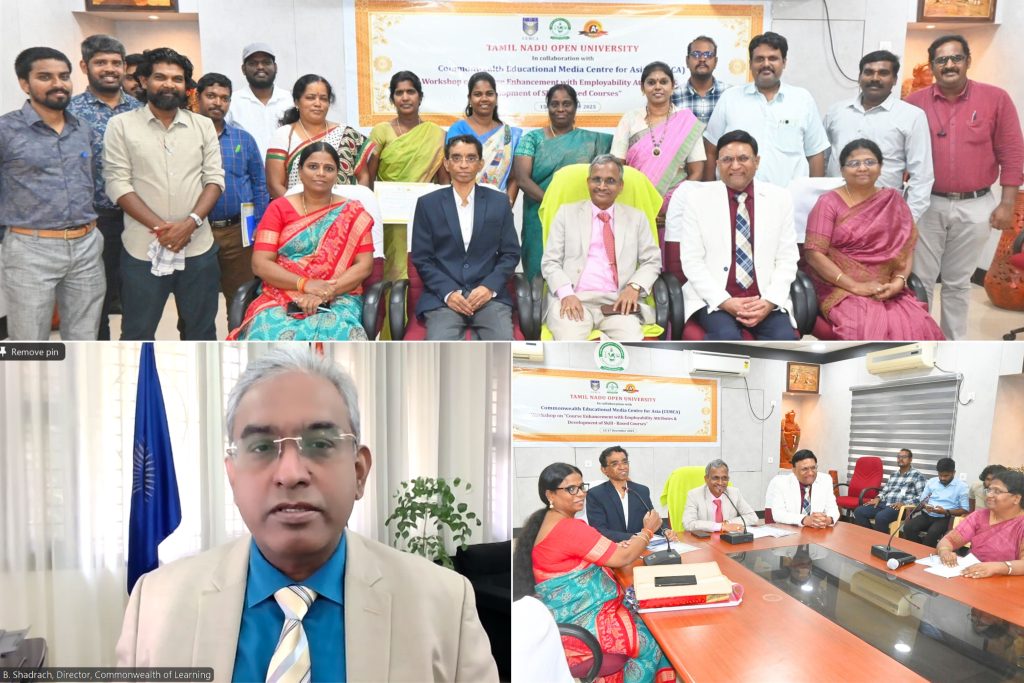
Chennai, 17 December 2025
A Curriculum Redesign and Enhancement Workshop for Graduate Employability was organised from 15-17 December 2025, jointly organised by the Commonwealth Educational Media Centre for Asia (COL-CEMCA) and Tamil Nadu Open University (TNOU).
Dr B. Shadrach, Director, COL-CEMCA, stressed embedding skills and competencies in the Open University curriculum to enhance graduate employability and the need for “skilling, reskilling, and upskilling.” He discussed the importance of competencies like critical thinking, communication, data analytics, and teamwork. He highlighted the need to bridge the gap between academia and industry, equipping learners with workplace-ready skills, and making the Open University placement-focused. He advocated for a backward design approach, defining end competencies, crafting authentic assessments, and implementing innovative instructional strategies that incorporated active learning, experiential opportunities, and ongoing feedback to refine the curriculum.
Professor Dr. S. Arumugam, Vice Chancellor, TNOU, emphasised aligning higher education with industry needs, highlighting the importance of graduate employability, skill development, and industry and institution linkages. He called the workshop “timely and relevant” as it aimed to redesign courses, embed employability attributes, and develop skill-based programmes, aligning with NEP 2020 and Skill India initiatives, to empower learners with skills, confidence, and employability.
Dr. S. Suresh Babuji, Director of the Ministry of Micro, Small and Medium Enterprises of India (MSME), Development Institute, Government of India, the chief guest for the workshop, emphasised the importance of skill development, employability, and industry-institution linkages. He appreciated the workshop’s focus on course enhancement and skill-based courses, and assured support for the initiative.
Dr. M Jayaprakashan, CEO of the Naan Mudhalvan, Skill Initiative under the Tamil Nadu Skill Development Corporation (TNSDC), underscored the importance of embedding skills into education, making it industry-relevant and accessible to all. He shared Tamil Nadu’s success in skilling 15 lakh students per semester, with industry partnerships and global certifications and advocated for localised, industry-driven curriculum, flexible assessment, and faculty training to ensure effective delivery. He stressed the need for a mindset change, focusing on student empowerment and societal impact, inspiring educators to drive positive change.
The expert trainer for the workshop, Dr O.P. Goel, Consultant, COL-CEMCA, emphasised bridging the gap between academia and industry. He set the goal for the workshop, focusing on reverse engineering industry expectations, exploring curriculum design, teaching methods, industry tie-ups, practical learning, and online support, to enhance graduate employability.
Mr T. V. Rajsekar, Executive Director of National Instructional Media Institute (NIMI), Chennai, emphasised skill development in India’s growth. He assured NIMI’s collaboration and support with TNOU on pedagogy, content development, and assessment support, stressing industry and academia collaboration and teachers’ training programmes.
Dr B. Shadrach, in his concluding remarks, highlighted embedding human-centric soft skills, digital-first hard skills, and self-management attributes into TNOU’s curriculum. He called for collaboration with NIMI, for technical courses, and to leverage district skill councils to map skills requirements, promoting local products globally. He stressed that the future of open universities lies in focusing on “skills and competencies”.
The workshop had participants from various disciplines, redesigning courses and developing skill-based blueprints, focusing on job roles and industry relevance. The workshop outcome included a proposed employability framework, aiming to enhance the curriculum in six courses at TNOU.
The three-day workshop concluded with a vote of thanks from Dr P. Chitra, Director, Centre for Electronic Media Production and Research (CEMPR), TNOU, who also moderated the sessions.