

Empowering Farmers through Lifelong Learning: A Roadmap for L3F 2.0
New Delhi, 21 January 2025
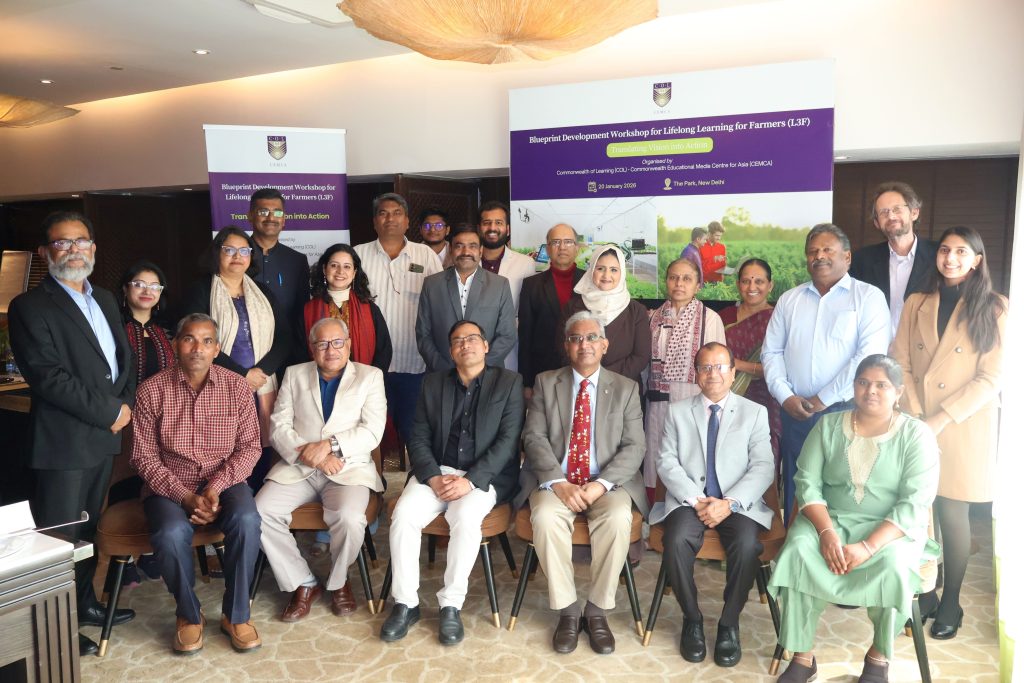
Commonwealth of Learning (COL) – Commonwealth Educational Media Centre for Asia (CEMCA), organised a “Blueprint Development Workshop for Lifelong Learning for Farmers (L3F) 2.0” (Translating Vision into Action) on 20 January 2026 in New Delhi, Delhi. The workshop was attended by around 20 dignitaries from various fields, stakeholders representing the government, the farming community, open universities, and the development sector.
The workshop aimed to develop an action roadmap for L3F 2.0, outlining governance, coordination, and scaling pathways. It sought to create a blueprint for strengthening and scaling L3F 2.0, leveraging technologies to advance lifelong learning for farmers.
Dr. B Shadrach, Director, COL-CEMCA, highlighted India’s diverse agricultural landscape and the need for context-specific solutions. He discussed the Lifelong Learning for Farmers (L3F) programme, emphasising the role of technology, including AI, in improving farming practices. To enhance farmers’ education, he emphasised the importance of micro learning, a practical and blended approach, peer learning, data-driven decision-making, and knowledge stewardship. He stressed that digital platforms and community participation are crucial, and addressing the needs of small and marginal farmers is essential. He set the goal for the project, which was to create inclusive and equitable agricultural development, recognising the collective responsibility of all stakeholders in the “ecosystem of learning.”
Mr Mrutyunjay Behera, Economic Advisor, Department of Higher Education, Ministry of Education, Government of India, highlighted the importance of trainers having hands-on farm experience, as many urban-educated trainers lack practical knowledge. He stressed teaching farmers in simple, local languages, avoiding jargon. He also emphasised leveraging existing platforms like Open Universities and Swayam to effectively reach farmers.
Dr. Nikhil Raj, Consultant, COL-CEMCA, and Nabeela Ata, Consultant, COL-CEMCA, led the sessions. Key discussions included institutional anchoring with universities, funding through financial institutions and partnerships, digital governance with credible information and taxonomy, and personalised learning through AI-driven responses.
The workshop highlighted challenges for farmers, especially women and marginalised, such as limited access to land, resources, and credits, as well as behavioural constraints and lack of opportunities for marketing and earning. The disinterest of youth in farming due to low returns and lack of honour was also discussed.
Key Outcomes of the Workshop:
- Learner centric approach: Farmers should have the choice to learn what they want, rather than being forced into a particular system.
- Microlearning and credits: Implementing microlearning courses and awarding credits can encourage learning and skill development.
- Incentivisation: Linking credits to subsidies, loans, or other benefits can motivate farmers to participate.
- Collective learning: Encouraging collective learning and peer-to-peer learning can enhance outcomes.
- Institutional support: Academic institutions and organisations can play a crucial role in standardising and accrediting learning.
Dr. B Shadrach, in his closing remarks highlighted three key strategies: Microlearning, which involves short-term training programs that can be monetised and credited; Blended Learning, combining formal and informal learning while recognising peer learning and leveraging technology; and utilising the Academic Bank of Credit, a platform allowing farmers to accumulate credits and access education. He called for collaboration among stakeholders and leveraging existing networks such as Krishi Vigyan Kendra (KVK), the Open University, and Open Schooling.