

COL-CEMCA, NAAC and IGNOU Convene National Workshop on Strengthening Quality Assurance in Online Education
New Delhi | 6 March 2026
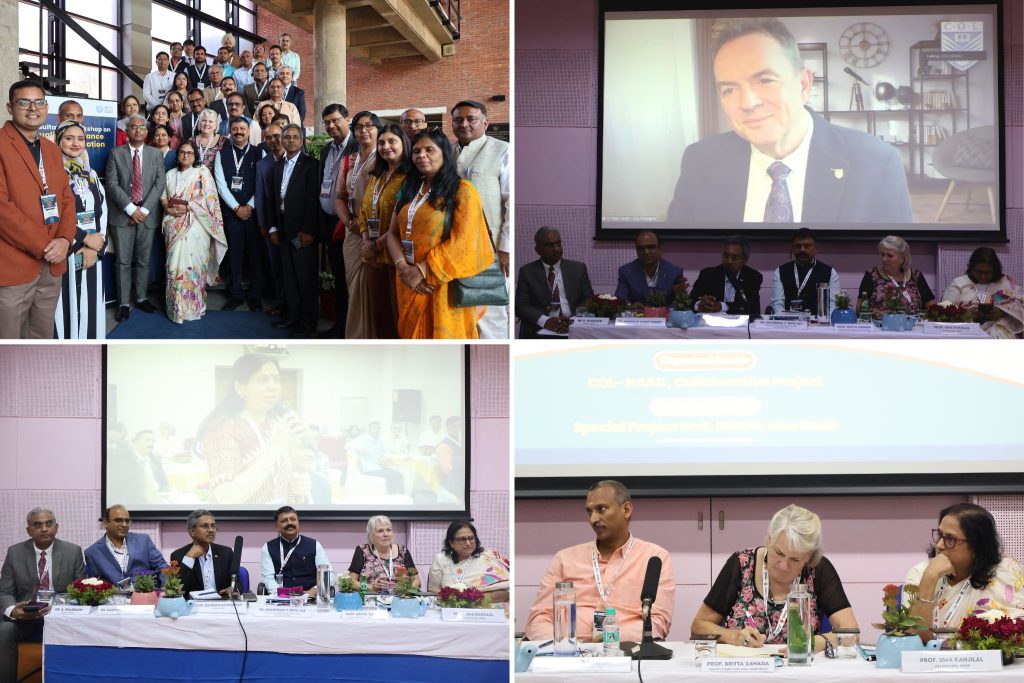
A two-day consultative workshop on Quality Assurance in Online Education commenced on 6 March at the Electronic Media Production Centre (EMPC), Indira Gandhi National Open University (IGNOU), organised by the Commonwealth of Learning (COL), Commonwealth Educational Media Centre for Asia (CEMCA), and the National Assessment and Accreditation Council (NAAC), in collaboration with the Special Project Unit at IGNOU.
Held under the theme “Transforming Indian Higher Education through Online Learning: Capacity Building for Improving Quality Assurance Systems,” the workshop brought together 22 leaders from higher education institutions, including vice-chancellors, directors, and heads of Centres for Internal Quality Assurance (CIQA), to deliberate on strengthening the quality and credibility of online education in India.
Welcoming participants, Prof Uma Kanjilal, Vice Chancellor, IGNOU, emphasised the growing importance of robust quality assurance frameworks as Indian universities increasingly adopt online and digital modes of learning to reach wider learner communities.
Prof. Ganesan Kannabiran, Director of NAAC, outlined the project’s phased approach, which includes identifying global and national best practices, developing a framework or handbook for quality online programme design, and piloting the framework with ten universities across India.
In his special address, Peter Scott emphasised the global importance of strengthening quality assurance in online education, highlighting that the consultative workshop represents a significant collaboration and marks the beginning of a joint project aimed at improving quality assurance frameworks for online education in India. He underscored India’s central role within the Commonwealth and described the country’s higher education ecosystem as one of the most dynamic spaces for advancing digital and online learning at scale.
Expert facilitator Dr. Britta Zawada, Council of Higher Education, South Africa, encouraged participants to openly share institutional experiences, stressing that the workshop provides a “safe space” for universities to reflect on challenges and identify risks in delivering quality online education.
Dr. B. Shadrach, Director, CEMCA, emphasised the global significance of India’s higher education system, noting that the country may soon produce one-fourth of the world’s tertiary degrees. As such, ensuring strong quality assurance in online education will be essential for maintaining credibility, supporting learner success, and shaping the future of global higher education.
Dr Madhukar Waware, Joint Secretary, Distance Education Bureau, UGC, stressed that evolving regulatory and accreditation systems must adapt to the realities of digital learning. He noted that institutions need clear frameworks, shared standards, and collaborative learning to effectively assure quality in online programmes.
Addressing participants, Sh. Anandrao Vishnu Patil, IAS, Additional Secretary at the Ministry of Education, Govt of India, emphasised that quality, relevance, and technology integration will define the future of learning in India. Highlighting the role of artificial intelligence and multilingual technologies, he noted that digital platforms can significantly expand access to education and improve learning efficiency across India’s diverse linguistic landscape.
The workshop is being facilitated by experts including Dr Britta Zawada, Prof. B. S. Balaji, and Prof. Uma Kanjilal, who are guiding discussions on emerging challenges and opportunities in digital higher education.
During the workshop, participants are examining the current status, opportunities, and challenges of online education in India, particularly in the context of the National Education Policy 2020 and efforts to expand the Gross Enrolment Ratio (GER) in higher education. Discussions focus on identifying key quality assurance considerations, analysing institutional capacity gaps, and outlining strategies for strengthening capacity-building initiatives.
Through collaborative group exercises over the two days, participants are expected to prioritise institutional capacity-building requirements and develop actionable strategies for improving quality assurance systems in online learning. The outcomes of the workshop are expected to contribute to strengthening institutional frameworks for delivering high-quality, scalable, and learner-centred online education in India.