

COL-CEMCA and MRIIRS Conduct FDP on Technology-enabled Learning and Blended Learning
New Delhi | 27 March 2026
The Commonwealth of Learning-Commonwealth Educational Media Centre for Asia (COL-CEMCA), in collaboration with Manav Rachna International Institute of Research and Studies (MRIIRS), conducted a five-day Online Faculty Development Programme (FDP) on “Empowering Higher Education Institutions in Technology-enabled and Blended Learning” from 23–27 March 2026. The FDP was organised under the Academic and Administrative Development Centres (AADCs) initiative of the Association of Indian Universities.
The FDP brought together faculty members from higher education institutions across India to strengthen their capacities in digital pedagogy, blended learning practices, and employability-focused education aligned with the goals of the National Education Policy (NEP) 2020.
The programme commenced with an inaugural session featuring welcome remarks by Dr. Shagufta Jabin, followed by the presidential address by Dr. Pardeep Kumar, Pro Vice Chancellor, MRIIRS. He emphasised the significance of faculty capacity building, institutional transformation, and the integration of technology in higher education systems. He further elaborated on the role of such interventions in fostering innovation, interdisciplinary collaboration, and policy-driven educational reforms, setting the tone for the FDP.
In his remarks, Dr. B. Shadrach, Director, COL-CEMCA, highlighted that the role of faculty is no longer limited to the transaction of knowledge, but has expanded to include facilitating learner success, supporting employability, enabling reskilling and upskilling, and preparing learners for a rapidly changing world. He underlined that higher education institutions must place learners at the centre of teaching-learning processes and support their academic, professional, and societal development.
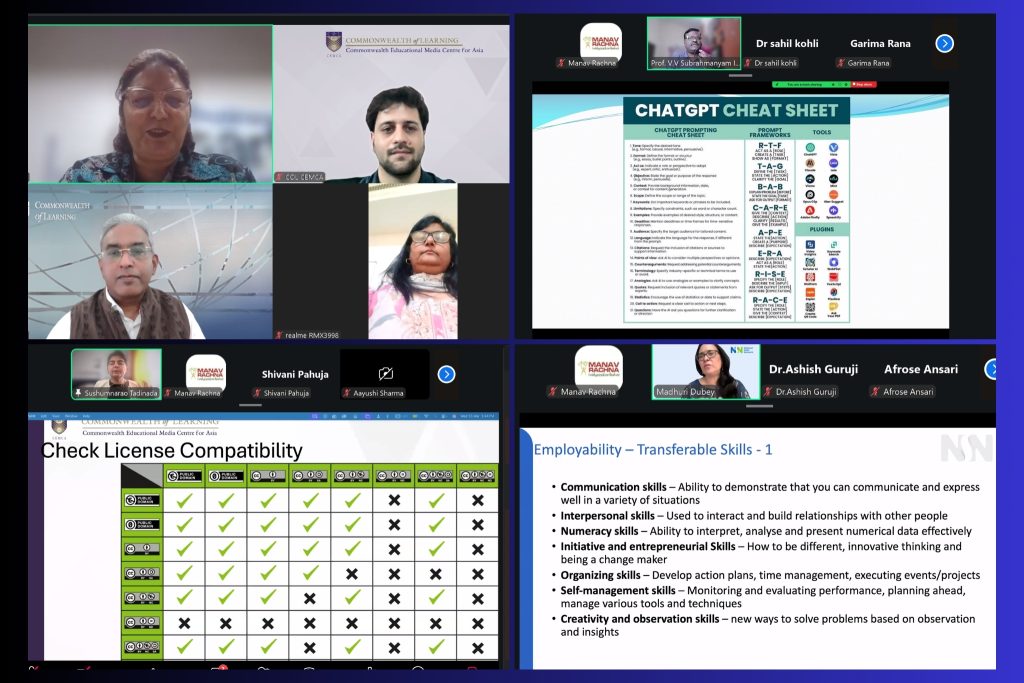
Day 1 focused on the salient features of NEP 2020, particularly its emphasis on digital and blended learning. Participants engaged in group activities to reimagine teaching-learning practices, encouraging collaborative reflection on institutional transformation.
Day 2 explored Technology-Enabled Learning (TEL) and Blended Learning, with a special focus on game-based learning as a formative assessment strategy. The session, led by Prof. Jeetendra Pande, combined conceptual understanding with hands-on practice.
On Day 3, participants were introduced to Open Educational Resources (OERs), MOOCs, and Learning Management Systems (LMS) by Ms. Sushumna Rao Tadinada. The session included practical exploration of OER repositories and strategies for integrating open resources into teaching.
Day 4 focused on Artificial Intelligence (AI) in teaching and learning, where Dr. V. V. Subrahmanyam highlighted applications suchA as personalised learning and AI-driven assessment, followed by hands-on exploration of AI tools.
The final day centred on Graduate Employability and Skilling, led by Dr. Madhuri Dubey. The session introduced COL’s Graduate Employability framework, with emphasis on micro-credentials, industry linkages, and institutional action planning. Participants developed actionable strategies to integrate employability within their academic programmes.