

Bridging Student Insight with Governance Practice | Public Policy Panel | India AI Impact Summit 2026
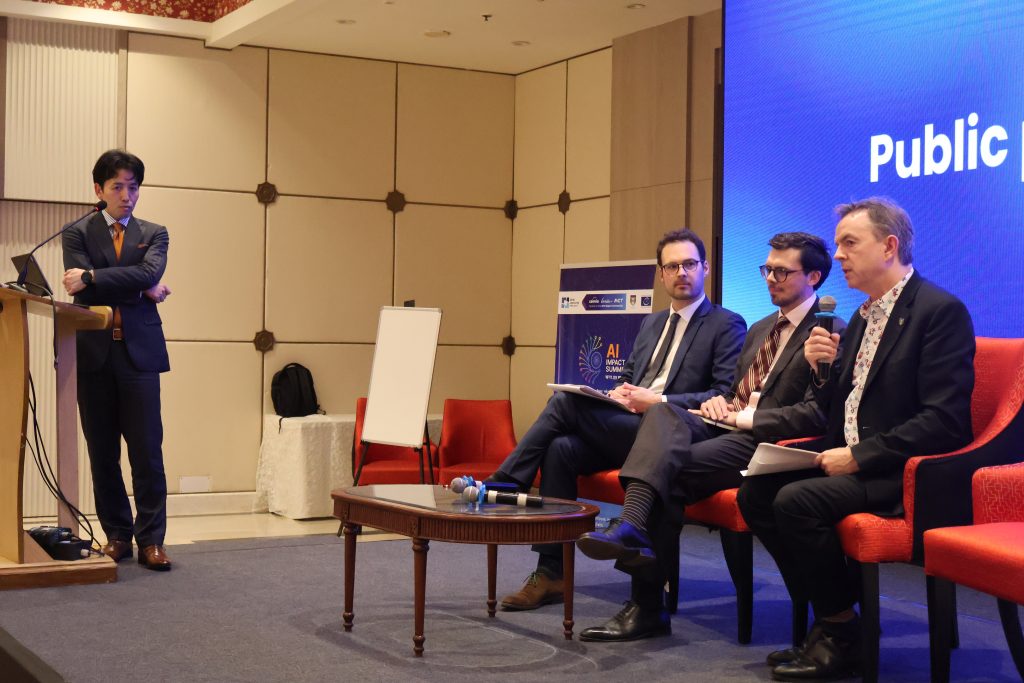
On 18 February 2026, during the Official Satellite Event of the India AI Impact Summit 2026, the Public Policy Panel brought governance leaders into direct dialogue with student-generated AI insights – testing what resonates, what’s realistic, and what can shape policy pathways within Global Partnership on Artificial Intelligence.
How do student-generated ideas travel into real governance systems?
Facilitated by Rentaro Iida, Senior Manager, GPAI Tokyo Expert Support Center, the Public Policy Reactions panel brought together:
- Prof Peter Scott, President & CEO, Commonwealth of Learning
- Mr Axel Froissart, Advisor for Digital & Emerging Technologies, Permanent Representation of France to the OECD
- Mr Daniel Pap, Legal Advisor, Digital Development Unit, Council of Europe
This session was not about endorsement. It was about resonance, realism, and pathways.
What Resonated at Policy Level
-
AI & Education: Alignment with OECD Analysis
Mr Axel Froissart noted that the students’ findings strongly aligned with the latest OECD Digital Education Outlook, particularly:
- The need for AI literacy
- Risks of cognitive offloading and disengagement
- The importance of tailored AI-supported learning
But he stressed a critical condition:
AI in education must be co-developed with users– especially students.
He also referenced the French “AI Cafés” initiative as an example of community-based AI literacy and collective appropriation of technology.
2️. Rights-Based Governance & Legitimacy
Mr Daniel Pap framed AI as both a global opportunity and a regulatory responsibility.
From a legal governance standpoint, what stood out was:
- The students’ emphasis on rights-based AI
- Their ability to engage substantively with governance frameworks
- The maturity of their discourse
The implication was clear: Youth contributions are no longer symbolic.They are compatible with international legal frameworks.
3️. Education Systems as Governance Infrastructure
Prof. Peter Scott reinforced that education is not peripheral to AI governance- it is foundational.
He connected student proposals to broader educational equity and access principles, positioning learning systems as:
- The bedrock of responsible AI futures
- A space where governance principles become lived practice
This panel created a bridge:
Student insight → Policy validation → Governance relevance.
It clarified which ideas:
- Are immediately aligned with ongoing OECD and Council of Europe discussions
- Require further testing
- Can realistically inform GPAI-linked activities
Most importantly, it demonstrated that student-generated frameworks are already speaking the language of governance institutions.