

Strengthening practical learning and industry linkages in school-based vocational education
Bhubaneswar, 30 October 2026
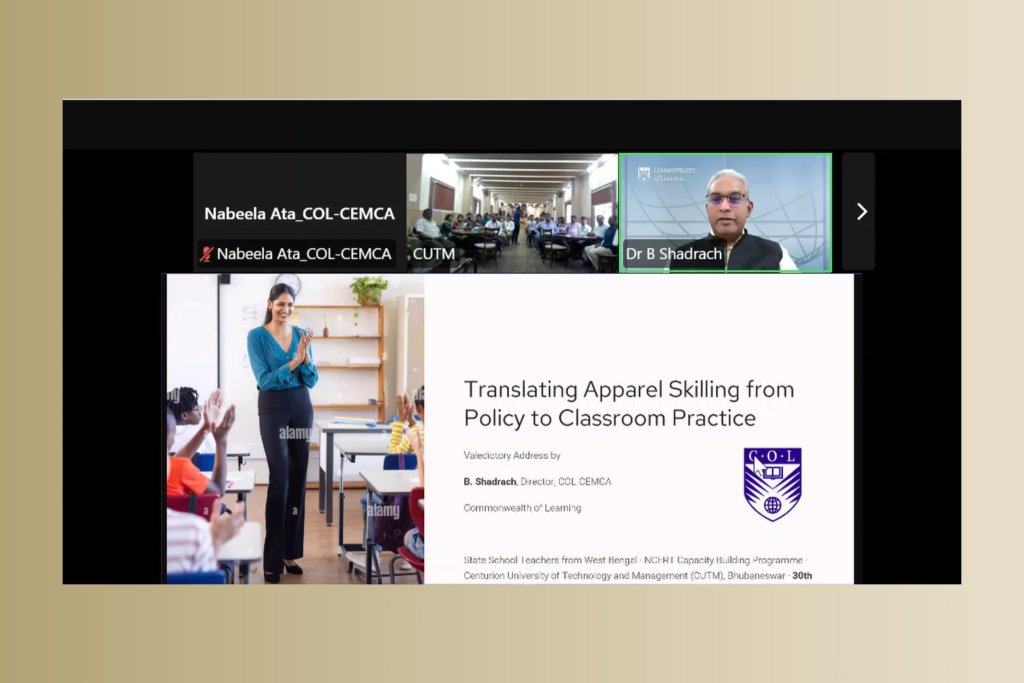
Vocational education has a critical role to play in shaping India’s future workforce, but its potential can only be realised when learning moves beyond theory into practical application, industry engagement and meaningful career pathways for students. Emphasising the importance of this transformation, Dr B. Shadrach, Director, Commonwealth Educational Media Centre for Asia (COL-CEMCA), called upon vocational teachers to become catalysts of change in school education during his address as Guest of Honour at the valedictory ceremony of a five-day capacity-building programme for vocational teachers in the apparel sector, held at Centurion University of Technology and Management (CUTM), Bhubaneswar, on 30 October 2026.
Organised by the Pandit Sunderlal Sharma Central Institute of Vocational Education (PSSCIVE), NCERT, in collaboration with CUTM, the programme was conducted from 26 to 30 October 2026 and brought together vocational teachers from West Bengal for intensive, hands-on training in apparel design and garment production.
Addressing the participants, Dr Shadrach emphasised that the vision articulated in the National Education Policy (NEP) 2020 and the National Curriculum Framework for School Education 2023 must translate into practical learning experiences for students. He noted that vocational education should not remain predominantly theoretical but must equip learners with competencies that connect directly with employment, entrepreneurship and opportunities for further education.
He urged the participating teachers to return to their institutions with a commitment to transforming classroom practices and outlined three important roles for vocational educators: becoming practitioners who prioritise hands-on learning, master trainers who share their knowledge and multiply its impact among fellow teachers, and champions of educational reform who actively engage with education authorities, industry and other stakeholders to strengthen vocational education.
Highlighting the importance of connecting schools with industry, Dr Shadrach encouraged teachers to explore partnerships with local production units and enterprises to provide students with workplace exposure, apprenticeships and opportunities to understand real-world production processes. He also stressed the need to make vocational education more aspirational by creating awareness of diverse career pathways, including formal employment, self-employment, micro-entrepreneurship and opportunities for academic progression.
The five-day programme provided participants with practical exposure to apparel production processes, including garment construction, embroidery, fabric manipulation and finishing. The programme coordinator highlighted its strong practice-oriented approach, with approximately 90 per cent of the training devoted to hands-on activities. Participants also showcased garments and other products developed during the programme.
Underscoring the transformative role of teachers, Dr Shadrach concluded that policy frameworks alone cannot change learners’ lives; meaningful change happens when teachers translate those commitments into practice in their classrooms. He encouraged the participants to carry forward the skills acquired during the programme and contribute to strengthening vocational education in their respective institutions and communities.
His address reinforced COL-CEMCA’s broader commitment to advancing relevant, practice-oriented vocational education and strengthening the capacity of educators to support inclusive, skills-based learning opportunities.