

COL-CEMCA and BOU Hold Stakeholder Consultation to Validate Blended TVET Curricula
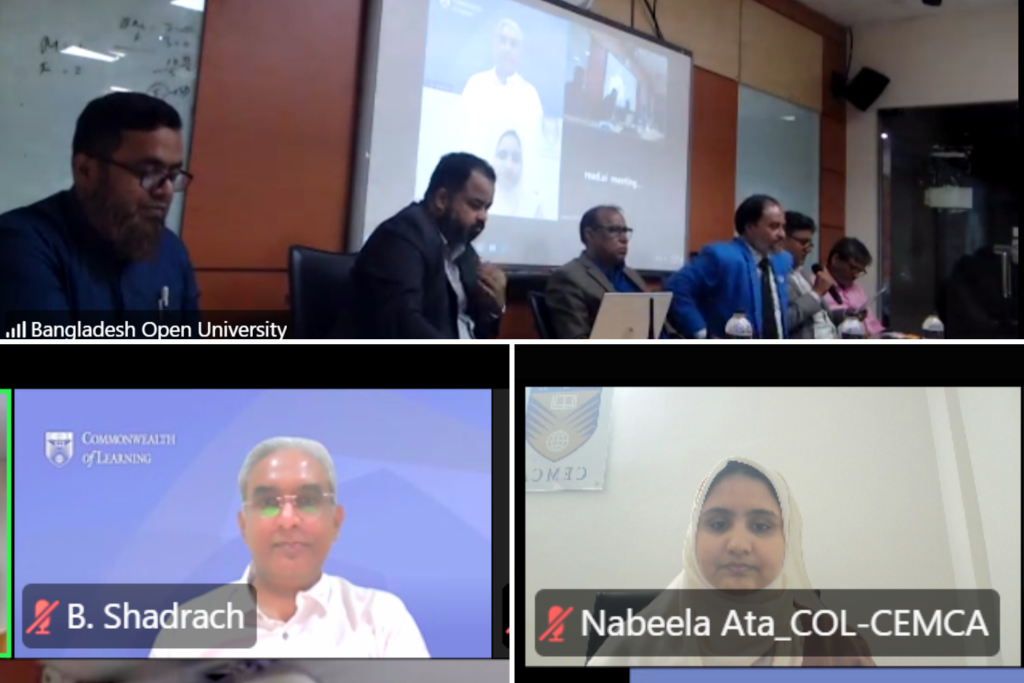
Gazipur, Bangladesh | 17 June 2026
The Commonwealth of Learning-Commonwealth Educational Media Centre for Asia (COL-CEMCA), in collaboration with Bangladesh Open University (BOU) hosted a day-long Stakeholder Consultation Workshop on Needs Assessment and Curriculum Design on 17 June, 2026 at its E-Learning Centre in Gazipur, Bangladesh.
The workshop, marks a significant milestone in the development of three competency-based blended certificate programmes: Disease Diagnosis, Garments Technology, and Advanced ICT Blended Pedagogy for Technical Teachers. The initiative is part of a broader effort to address the skills gap between educational outcomes and industry requirements in Bangladesh.
The inaugural session was presided over by Professor Dr. Mohammad Siddiqur Rahman Khan, Vice-Chancellor of Bangladesh Open University, who formally inaugurated the workshop. Professor Dr. Anisur Rahman, Pro-Vice-Chancellor (Academic), and Professor Dr. Md. Serajul Islam, Pro-Vice-Chancellor (Administration), attended as Guests of Honour.
Delivering remarks on behalf of COL-CEMCA, Dr. B. Shadrach, Director, joined the proceedings online from India and underscored the significance of blended TVET for Bangladesh’s development trajectory. He noted that with over 120 million people of active working age and a government target of reaching 2.6 million young people through TVET by 2030, the demand for flexible, technology-enabled skills training had never been more urgent. Dr. Shadrach acknowledged COL-CEMCA’s ongoing partnerships across Commonwealth Asia — with BOU in Bangladesh, the Ministry of Education in the Maldives, the Open University of Sri Lanka, Allama Iqbal Open University in Pakistan, and the National Council for Vocational Education and Training in India.
In his inaugural address, Vice-Chancellor Professor Dr. Mohammad Siddiqur Rahman Khan emphasised that the three certificate programmes had been selected based on national priorities and that curricula must be competency-based, industry-responsive, technology-enabled, inclusive, and aligned with national and international qualification standards. He called upon all participants — drawn from industry, academia, government, and civil society — to contribute actively to shaping training frameworks that would support Bangladesh’s transition toward an upper-middle-income, knowledge-based economy.
The technical sessions, moderated by Dr. Md. Zakir Hossain Talukder (Additional Director, IQAC, BOU) and Md. Sabbir Hossain, covered draft curriculum presentations and validation exercises across the three programme areas: Apparel, Fashion and Garment Production; Health Technology Operation and Management; and TVET Programmes, Policies and Standards Mapping. The afternoon session focused on policy alignment and the way forward, drawing together outputs from technical group discussions.
Outputs from the workshop will inform the finalisation of competency-based curricula across all three certificate programmes, with BOU and COL-CEMCA working toward their adoption within BOU’s Institute of Technical and Vocational Education and Training (ITVET) as part of a wider Commonwealth-supported initiative to expand blended TVET access across Asia.